
PRP for Knee Osteoarthritis: What the Evidence Can and Cannot Tell Patients
Knee arthritis can turn small decisions into calculations. Is the parking spot close enough? Will the stairs hurt today? Can you play eighteen holes, take a long walk, or finish a workout without paying for it that evening?
When exercise, medication, weight management, or other treatments haven't provided enough relief, people often ask about platelet-rich plasma, or PRP. They usually want a straight answer: Does it work, and am I a good candidate?
The honest answer has some nuance. Research suggests that PRP may reduce pain and improve function for some people with knee osteoarthritis. The results aren't consistent across every trial, preparation method, or patient group. PRP doesn't rebuild a worn knee, and it can't promise that surgery will never be needed.
Here's what the evidence can help us say, and where uncertainty remains.
What is happening in an arthritic knee?
Osteoarthritis involves more than cartilage wear. The bone beneath the cartilage, joint lining, surrounding muscles, and the way force moves through the leg can all contribute to symptoms.
Common experiences include:
- stiffness after sitting or first thing in the morning.
- pain with stairs, squats, hills, or longer walks.
- swelling after activity.
- a grinding or rough sensation.
- reduced confidence in the knee.
- difficulty returning to exercise after a flare.
An X-ray may show joint-space narrowing or bone spurs, but the image doesn't tell the whole story. Some people have substantial changes on X-ray and modest symptoms. Others have significant pain with less dramatic imaging. Treatment decisions should connect the symptoms, examination, activity goals, and imaging rather than relying on one picture.
What is PRP?
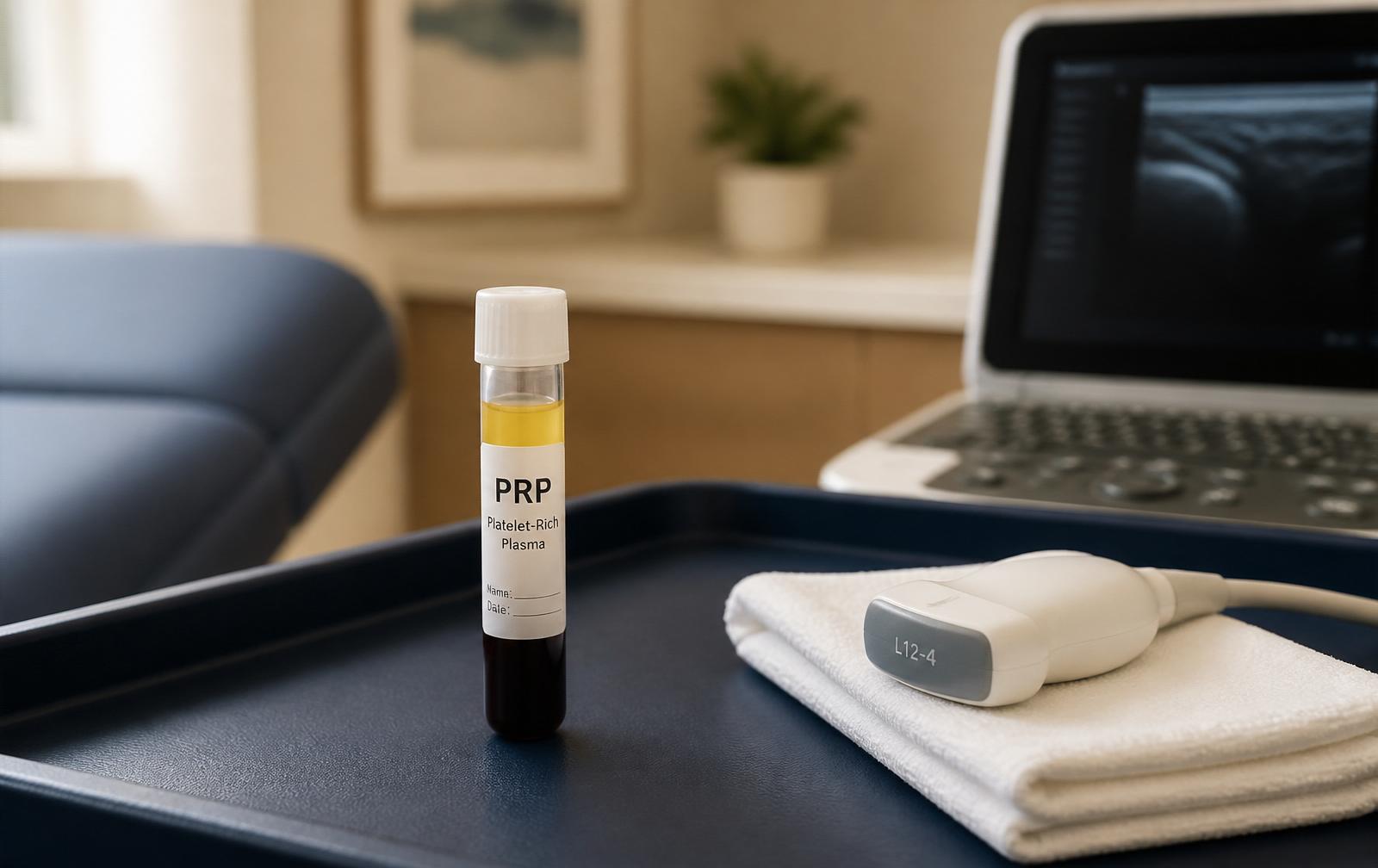
PRP is prepared from a sample of your own blood. The blood is processed to concentrate platelets in a smaller volume of plasma. Platelets contain signaling proteins involved in inflammation and tissue response.
The prepared product is then injected into the knee. At Arc Med Health, an injection would be considered only after an evaluation and discussion of the diagnosis, alternatives, expected limitations, and risks. Ultrasound guidance may be used to visualize the joint and guide needle placement, but accurate placement doesn't guarantee a particular clinical result.
PRP products aren't all identical. Systems differ in platelet concentration, white-blood-cell content, volume, processing, and the number and spacing of injections. That variation is one reason studies don't always agree.
What does the evidence show?
Several systematic reviews and randomized trials have reported improvement in pain and function after PRP for knee osteoarthritis, particularly over several months. A 2023 network meta-analysis found favorable pain and function results for PRP and PRP combined with hyaluronic acid compared with several other injection approaches.[1] A 2024 review of randomized trials also found advantages for PRP, while warning that many results were statistically fragile and could change with a small shift in outcomes.[2]
There are also well-designed studies that did not show a meaningful benefit over placebo. In the RESTORE randomized trial, three weekly injections of leukocyte-poor PRP did not produce a significant difference in pain or cartilage volume compared with saline at twelve months.[3]
The American Academy of Orthopaedic Surgeons states that PRP may reduce pain and improve function in symptomatic knee osteoarthritis, but rates the recommendation as limited because results are inconsistent and treatment methods vary.[4]
Taken together, the evidence supports a careful conversation, not a promise. Some patients improve. Some don't. The research hasn't established one protocol that reliably works for everyone.
What kind of improvement is realistic?
The goal is usually symptom relief and better function. That may mean walking farther, tolerating stairs more comfortably, returning to modified exercise, or having fewer flares.
PRP should not be described as replacing lost cartilage or reversing osteoarthritis. Current clinical evidence does not show that a knee injection restores a worn joint to normal. The RESTORE trial did not find preservation of medial tibial cartilage volume compared with placebo at twelve months.[3]
Improvement, when it occurs, may take several weeks. Duration varies. A person may have meaningful relief for months, a brief change, or no noticeable benefit. Future treatment still depends on symptoms, function, and how the knee changes over time.
Who may be reasonable to evaluate for PRP?
PRP may be worth discussing when knee osteoarthritis is causing persistent symptoms despite an appropriate conservative plan and the person understands the uncertainty.
The conversation may be more relevant for someone who:
- has mild to moderate osteoarthritis rather than a severely collapsed joint.
- wants to remain active and has specific functional goals.
- has tried a well-designed exercise or rehabilitation program.
- cannot take certain medications or has not obtained enough relief from them.
- is not ready for joint replacement or is not currently a surgical candidate.
- understands that PRP is usually self-pay and results vary.
Age alone doesn't decide candidacy. Neither does an X-ray grade. Alignment, range of motion, strength, swelling, body weight, metabolic health, prior surgery, medications, and the source of pain all matter.
When might PRP be a poor choice?
An injection may not address the main problem if pain is coming from the hip, back, a stress fracture, an unstable meniscus injury, severe mechanical deformity, infection, inflammatory arthritis, or another diagnosis.
PRP may also be inappropriate or require additional planning when a patient has an active infection, certain blood disorders, significant anemia, poorly controlled medical conditions, or uses medications that affect bleeding or platelet function. Medication decisions should be made with the prescribing clinician. Don't stop a medication on your own to prepare for PRP.
Advanced osteoarthritis doesn't automatically rule out every nonsurgical option, but expectations deserve extra care. A severely narrowed joint with major loss of motion or deformity may be less likely to respond enough to meet the person's goals. In that situation, delaying a useful surgical consultation can cost time without improving function.
What should happen before the injection decision?
A focused evaluation comes first. The clinician should ask where the pain is felt, how long stiffness lasts, what causes swelling, what the knee can no longer do, and which treatments have already been tried.
The examination may look at walking, alignment, swelling, range of motion, strength, hip control, ligament stability, and movements that reproduce symptoms. Weight-bearing X-rays are often useful for understanding osteoarthritis severity and alignment. Ultrasound can answer selected questions about fluid, synovial irritation, tendons, bursae, and other superficial structures.
That visit should end with a working diagnosis and options. PRP is one possible part of a plan. Exercise therapy, changes in training load, weight management when relevant, topical or oral medication, bracing, other injections, and surgical consultation may also deserve discussion.
What are the risks and practical considerations?
Temporary soreness, swelling, stiffness, or bruising can occur after the procedure. Infection, bleeding, injury to nearby structures, and a significant inflammatory reaction are less common but important risks. Because PRP comes from the patient's own blood, an allergic reaction to the PRP itself is not the usual concern, although other materials used during a procedure can still cause reactions.
Ask how the product is prepared, whether imaging guidance will be used, how many injections are being proposed, what activities should be modified afterward, and when progress will be reassessed.
You should also know the full cost before scheduling. Insurance coverage for PRP is limited, and many plans consider it investigational for knee osteoarthritis.
Questions worth asking during a PRP consultation
- What findings support knee osteoarthritis as the source of my symptoms?
- How advanced are the changes, and how does that affect expectations?
- What treatments should I try before an injection?
- Which PRP preparation and protocol do you use, and why?
- What improvement would count as a successful result for me?
- How long should I wait before judging the response?
- What are the alternatives if PRP doesn't help?
- Is there any reason I should speak with a surgeon now rather than later?
A useful consultation should leave room for all of those questions.
What should you take away?
PRP may help selected patients with painful knee osteoarthritis, but the evidence is mixed and the average result doesn't predict one person's response. It may improve symptoms and function. It has not been shown to restore a worn knee or guarantee avoidance of surgery.
The decision makes the most sense after the diagnosis is clear, proven conservative options have been considered, and the expected benefit is meaningful for your goals. If the conversation sounds certain or promises cartilage regrowth, ask for the evidence behind that claim.
References
- Qiao X, et al. Efficacy and safety of corticosteroids, hyaluronic acid, PRP and combination therapy for knee osteoarthritis: a systematic review and network meta-analysis. BMC Musculoskeletal Disorders. 2023. PMID 38037038.
- Platelet-Rich Plasma Versus Alternative Injections for Osteoarthritis of the Knee: a systematic review and fragility-index meta-analysis. American Journal of Sports Medicine. 2024. PMID 38420745.
- Bennell KL, et al. Effect of intra-articular platelet-rich plasma vs placebo injection on pain and medial tibial cartilage volume in patients with knee osteoarthritis: the RESTORE randomized clinical trial. JAMA. 2021. PMID 34812863.
- American Academy of Orthopaedic Surgeons. Management of Osteoarthritis of the Knee, Non-Arthroplasty, Evidence-Based Clinical Practice Guideline.
Medical disclaimer
This article provides general educational information and is not a diagnosis or a substitute for individualized medical advice, examination, or treatment. PRP candidacy, medication instructions, imaging, and rehabilitation depend on the patient's history, examination, health conditions, and goals.
Frequently asked questions
Does PRP regrow knee cartilage?+
How long does PRP take to work?+
How many PRP injections are needed?+
Is PRP better than cortisone or hyaluronic acid?+
Will insurance pay for PRP?+
References
- Qiao X, et al. Efficacy and safety of corticosteroids, hyaluronic acid, PRP and combination therapy for knee osteoarthritis: a systematic review and network meta-analysis. BMC Musculoskeletal Disorders. 2023. PMID 38037038.
- Platelet-Rich Plasma Versus Alternative Injections for Osteoarthritis of the Knee: a systematic review and fragility-index meta-analysis. American Journal of Sports Medicine. 2024. PMID 38420745.
- Bennell KL, et al. Effect of intra-articular platelet-rich plasma vs placebo injection on pain and medial tibial cartilage volume in patients with knee osteoarthritis: the RESTORE randomized clinical trial. JAMA. 2021. PMID 34812863.
- American Academy of Orthopaedic Surgeons. Management of Osteoarthritis of the Knee, Non-Arthroplasty, Evidence-Based Clinical Practice Guideline. 2021.
Have questions about your care?
Talk with our clinical team about whether PRP may be reasonable for your knee.